Is Linen Bedding Sustainable? What to Look For When Buying
“Sustainable bedding” is one of those phrases that sounds useful until you try to pin it down. Brands use it for everything from organic cotton to recycled polyester to vaguely earthy packaging. That's why people keep asking “is linen bedding sustainable?” or, “what to look for when buying bedding”. The short answer is yes, linen can be a very sustainable choice, but only when you look past the label and check how it was grown, processed, finished, and made.
The most popular advice tends to stop at “linen is natural, so it's better”. That's incomplete. Natural fibres can still be poorly processed, over-finished, or sold with very little supply chain transparency. Good linen deserves a more honest answer than a marketing slogan.
Looking Beyond the Label
Linen bedding can be sustainable, but not all linen bedding is. The fibre itself gives it a strong head start. The finished product only earns that reputation if the brand can show responsible sourcing, safer processing, and long wear over time.
When you're choosing bedding, it's worth looking beyond the fibre itself. Sustainability isn't only about how something is grown. It's also about what happens next - how it’s processed, what finishes are added, how long it lasts, , and whether it’s made to be used and loved for years rather than replaced after a season
A thoughtful approach to sustainability starts with quality. Natural fibres, low-impact manufacturing, safer chemical standards, and products designed to last all play a part. The goal isn't simply to buy something labelled sustainable, but to choose bedding you'll genuinely want to live with for years to come.
That's the philosophy behind our approach to bedding. We believe in buying less, buying better, and creating products that are made to be used, enjoyed, and kept. You can learn more about our sustainability practices here.
The Questions That Don't Tell the Whole Story
When it comes to sustainable bedding, a few questions tend to dominate the conversation:
- Is it natural?
Natural helps, but it's not the whole story.
- Is it expensive?
Price can reflect better fibre and craftsmanship, but cost alone doesn't prove anything.
- Does it have a green label?
Some labels mean a lot. Some mean almost nothing.
Practical rule: Don't treat “linen” as the final answer. Treat it as the starting point.
The better way to think about bedding is to be more grounded. Ask what the fiber is, where it came from, how it was processed, what was added to it, and whether you'll still want to use it years from now. That last part often gets ignored, even though it's one of the most meaningful parts of buying well
A more useful definition
For bedding, sustainability usually comes down to five things:
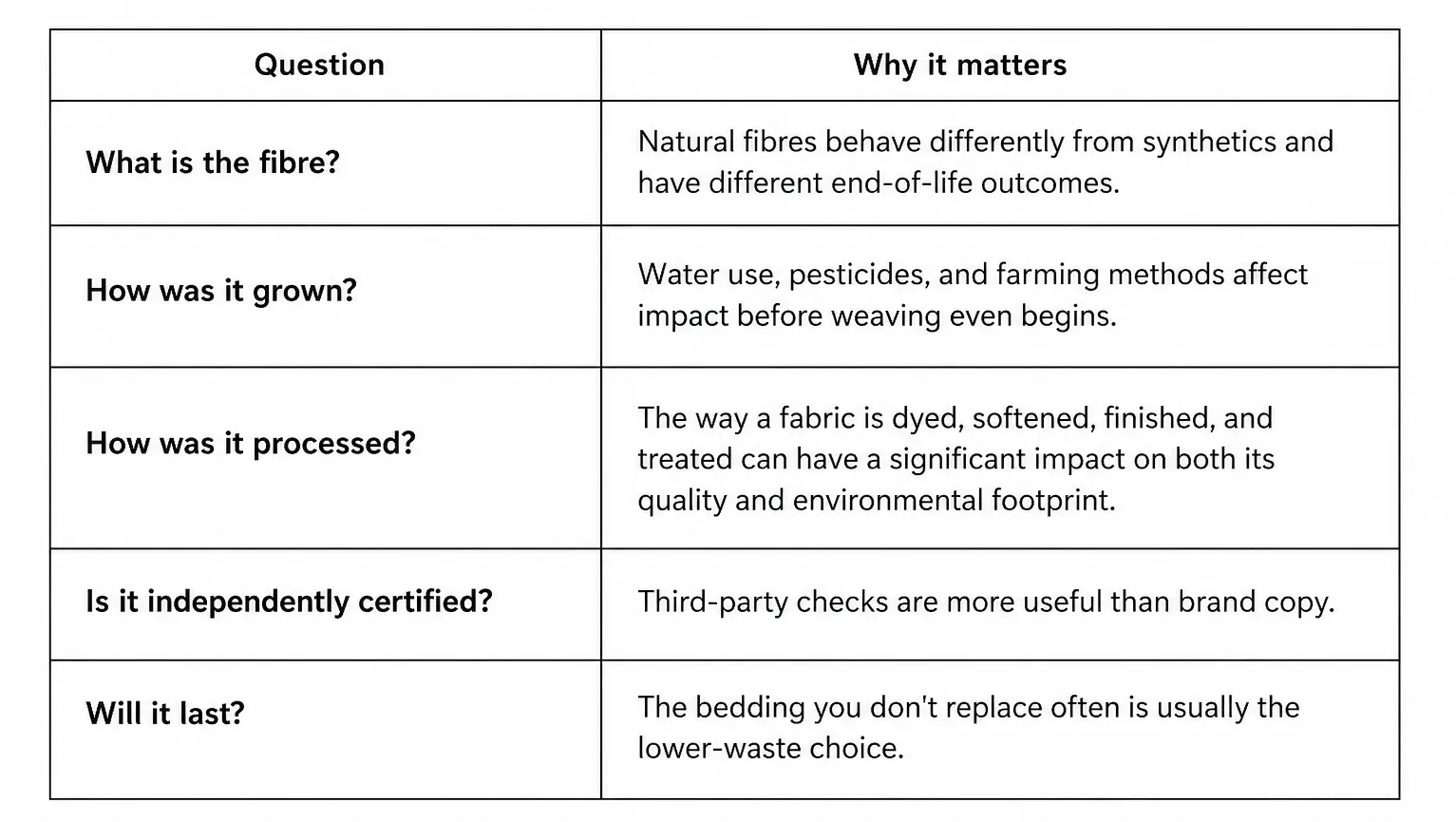
That's the lens worth using. Linen often performs well against those measures, but no fibre gets a free pass.
The Natural Advantage From Plant to Fabric
Linen's environmental case starts long before a sheet reaches your bed. It starts with flax, the plant linen is made from, and flax usually asks less of the land than many people expect.
Why flax gets so much attention
A good way to understand flax is to compare it with a crop that needs constant support versus one that is better suited to its environment. In the main European flax-growing regions, the crop is typically rain-fed, which lowers pressure on freshwater supplies. The European Commission's product environmental footprint work on T-shirts also identifies fibre production as a meaningful part of a textile product's overall impact, especially through water use and farming inputs.
That helps explain why linen appears so often in sustainability discussions. If the raw fibre needs less irrigation and fewer interventions at the farm stage, the starting point is usually stronger.
What this means for bedding
A lower-input crop can matter in a few practical ways:
- Less strain on freshwater resources during cultivation
- Less reliance on intensive irrigation infrastructure
- A simpler farming profile than fibres that need heavier intervention to grow well
It's a promising beginning and good foundations help, but what happens next matters just as much.
Flax can begin with a lighter footprint, yet spinning, weaving, dyeing, finishing, transport, and how long the bedding stays in use still shape the real outcome.
It's not only about water
Flax is also often valued because it can be grown with fewer inputs than more intensive conventional fibre crops, depending on region and farming method. But sustainability is rarely defined by a single measure. It is about the full chain of pressures, from water and soil health to chemical use and waste.
Then there is the question of what the fabric is made of at the end of its life. Linen is plant-based rather than petroleum-based, which gives it a better end-of-life story than polyester in many cases. But shoppers should be careful with the word “biodegradable.” Pure natural fibre behaves very differently from fabric blended with synthetics, coated for easy care, or finished with plastic-based treatments.
That is why the most honest version of the linen story is this: flax often gives linen a better starting position, but the plant alone does not make the finished bedding sustainable. The farm matters. The mill matters. The finishes matter. And the product has to be good enough to keep, wash, mend, and love for years.
Decoding the Labels A Guide to Certifications
Certifications can be helpful, but they’re not a shortcut for understanding the whole product. Each one tells you something specific — about the fibre, the finished fabric, the origin, or the way it was made. The useful bit is knowing what each label can prove, and what it can’t.
OEKO TEX Standard 100
For bedding, this is often the first label to check because it focuses on the finished product, the fabric that will sit against your skin night after night. The New Zealand-focused note on PFAS and OEKO-TEX explains that a ban on PFAS chemicals in textiles is expected to take effect in July 2026 in New Zealand, and points to OEKO-TEX as one way shoppers can look for products tested for these and other substances of concern.
OEKO-TEX Standard 100 does not tell you the flax was organically grown. It does not certify the full environmental story from farm to factory. It answers a narrower, very practical question. Has the finished bedding been tested for harmful substances?
That is why this label is so useful on sheets and pillowcases. Bedding is not a decorative object you touch once in passing. It is close-contact fabric.
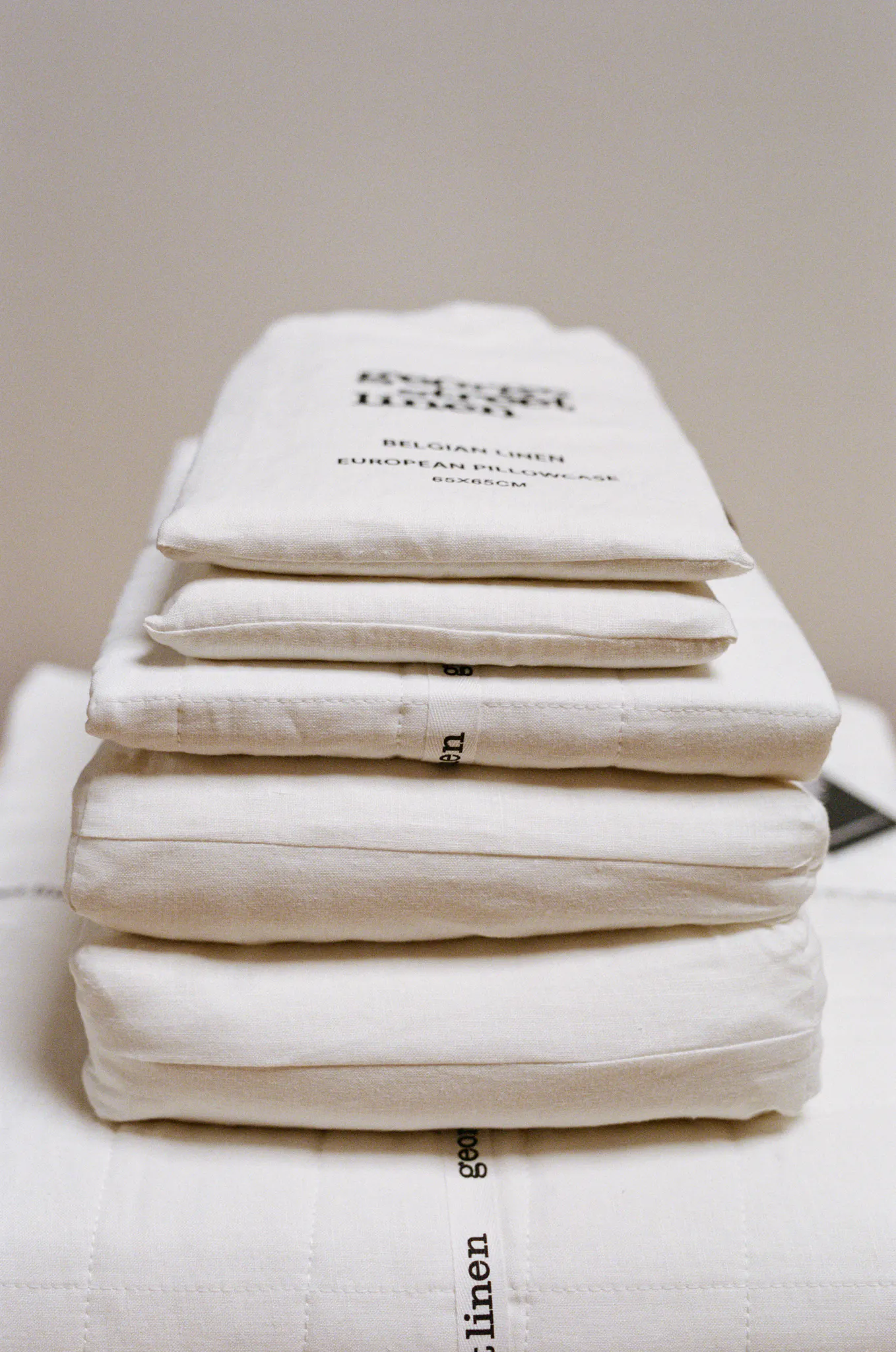
All George Street Linen products are OEKO-TEX certified. For us, that's not a marketing badge—it's a baseline. Bedding spends hours against your skin every night, so we believe every component, from fibres and threads to buttons and zips, should meet recognised safety standards.
Our approach starts with carefully sourced natural fibres and extends through every stage of production, from safe dyes and responsible manufacturing to rigorous testing and certification. Because quality isn't just about how bedding looks or feels. It's also about knowing exactly what's in it.
You can read more about our commitment to fabrics, quality, and certification here.
GOTS
GOTS stands for Global Organic Textile Standard. If OEKO-TEX is mainly about what is in the finished fabric, GOTS looks more broadly at the fibre and production chain.
GOTSverifies that an organic claim is tied to a recognised standard rather than marketing language. It is especially relevant if organic fibre content is high on your list. You will not see it on every good linen product, but when a brand has it, the claim carries more weight ...because it has been assessed against an independent certification standard.
European Flax
European Flax is best read as an origin and traceability signal. It tells you the flax was grown in recognised parts of Europe, where linen has a long agricultural and manufacturing history.
That does not mean every product with this label is automatically low-impact in every other way. Spinning, weaving, dyeing, finishing, and sewing still matter. But origin matters in linen, just as terroir matters in wine or long-staple length matters in cotton. It gives you one solid piece of the story.
What each label helps you answer
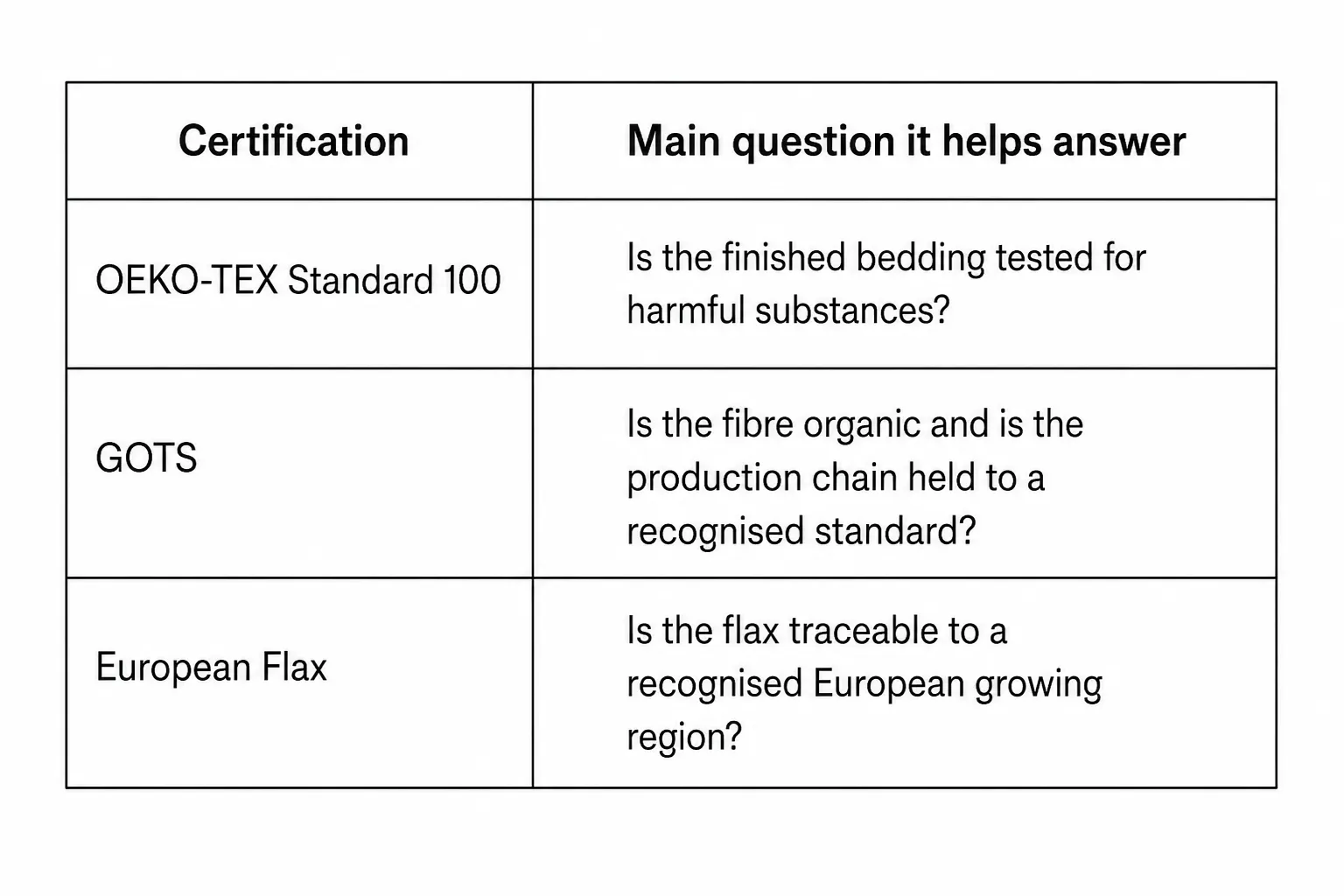
A good rule of thumb is to match the label to the claim: If a brand talks about skin safety, look for OEKO-TEX. If it talks about organic fibre, look for GOTS. If it highlights flax origin, look for European Flax.
Buying advice: Verify the certification before you trust the marketing copy.
A trustworthy brand also makes the claim easy to check. The logo should not be doing all the work. You should be able to understand what the certification covers, and just as clearly, what it does not.
Your Checklist for Buying Genuinely Sustainable Linen
A product page should answer the same questions you would ask in a good fabric shop. What is this made from? Where did it come from? How was it finished? Will it still feel good after years of washing? If a brand cannot answer those basics clearly, treat the sustainability claim with caution.
- Start with fibre composition. Choose 100% linen or 100% flax linen if you want the clearest picture of what the fabric is and how it may break down at the end of its life. Blends can still be useful, but they muddy the picture.
- Check certifications after that. OEKO-TEX Standard 100 is helpful for bedding because it applies to the finished product that sits against your skin. GOTS and European Flax tell you different things, so read them as clues rather than a single pass or fail stamp.
- Read past the marketing line. “Designed in” says very little about supply chain reality. “Flax grown in Europe, woven in, dyed in, sewn in” gives you something concrete to assess.
- Look for supply chain detail. A careful brand often names its mills, makers, or regions of production. That level of specificity works like a receipt. Vague wording usually means you are being asked to trust the mood, not the evidence.
- Pay attention to finishing. Garment-washed linen can be a sensible choice because it softens the fabric mechanically. Claims like stain-resistant, wrinkle-proof, or water-repellent deserve a closer look because those results usually come from added treatments.
- Check the small things. Buttons, stitching, closure quality, and fabric weight all affect how long bedding stays in use. Sustainability is rarely one heroic feature. It is often a series of quiet, durable decisions.
- Look at packaging too. Recyclable, low-plastic packaging will not redeem a poor product, but it does tell you whether the brand has thought beyond the first impression.
- Consider what happens when the bedding reaches the end of its usable life. Undyed, 100% linen has a simpler afterlife than synthetic bedding. Once you add blended fibres, heavy coatings, or complex trims, disposal becomes less straightforward.
What transparency looks like in practice
A brand's philosophy should show up in its product information, not just in a polished About page. An “Our Craft” page can be useful if it explains materials, finishing methods, and why certain design choices were made for repeated use. General phrases like “conscious luxury” or “eco comfort” tell you far less
5 things worth checking
- Natural fibre. Choose 100% flax linen where possible.
- OEKO-TEX certified. Check that the finished bedding is tested for harmful substances.
- Traceable sourcing. Look for clear information on fibre origin, weaving, dyeing, and sewing.
- Built for long use. Prioritise quality construction and restrained finishing.
- Clear brand language. Buy from brands that explain their mills, materials, and packaging plainly.
A Considered Choice for Your Home and the Planet
Linen earns its reputation when the whole picture holds together. A natural fibre with lower water demands, careful processing, independent certification, and real longevity is a strong answer to the sustainability question. A vague “eco” label on an over-finished product isn't.
The most responsible bedding choice is rarely the most disposable one. It's the one you'll use, care for, and keep for years. That's what makes linen such a thoughtful option for people who want a home that feels good and reflects their values.
If you're choosing bedding with a long view in mind, explore George Street Linen for natural-fibre pieces designed around comfort, durability, and everyday use. The right sheets aren't just a purchase. They're part of how you live, sleep, and buy more carefully.
Explore Our Pure Linen Collection
Made from European flax and OEKO-TEX certified, our pure linen bedding is thoughtfully crafted for everyday comfort and long-term use. Every component is tested for harmful substances, so you can rest easy knowing the fabric against your skin meets recognised safety standards.
Explore our Pure Linen Collection →